
Share



A first-hand case study on local government reorganisation (LGR).

Dealing with uncertainty can be challenging, and I’ve experienced this first hand. At the time, it was never entirely clear which proposal would be approved. There were two possible options; one was to create a single unitary authority covering the county and its six districts, an option that was ultimately taken. The other was to divide the county into two, with the southeast urban area and two of the six districts forming one authority, and the remaining four more rural districts and that part of the county forming another.
One positive aspect of the process was that someone stepped up to take a lead role and could see an opportunity. However, it was not obvious to everyone to do that, as the lead was a senior officer from one of the districts. There was no formal management committee in place that made key appointments to oversee this area. It often felt as though the county was driving all the decisions, yet the county council lacked the necessary expertise in several district level functions address gazetteer management being one clear example.
This helped bring colleagues together across the Geospatial area, including address, street, and GIS officers. SNN was overlooked at the time, though this was back in 2009. While it was valuable to meet up and discuss key activities, everyone was aware that there could be competition for future job roles, which made the situation understandably nerve wracking for all involved.

We needed to benchmark good practice, and although a data health check was available at the time, it is clear how much substantial work the Improvement Schedule Working Group has delivered over the past decade. The benchmarking efforts helped identify where further improvements were needed and supported the development of minimum standards.
The group shared their experiences, and over the following weeks and months these discussions evolved into detailed conversations about the roadmap, including how the unitary LLPG would be created. Throughout this process, we were fully aware of the risks, particularly because all planning, building control, and land charges systems were directly connected to their individual LLPGs. The unitary authority was not in a position to implement a single planning system before Vesting Day, and the existing software contract provided no opportunity to procure a new system in advance.
Even if it had been possible, it is difficult to imagine the implementation being successful after Vesting Day, it ultimately took three to four years to adopt a single planning system and to migrate planning data from the legacy systems into the new unitary structure. In many cases, planning services continued operating exactly as they had before LGR for some time. Interoperability was a major issue, as systems did not and often could not communicate with one another at that time.
Looking ahead, one potential opportunity is to explore how the MHCLG planning application dataset could provide a simpler and more efficient method for migrating data between different planning systems, making future transitions between solutions far more straightforward.
We carried out soft market testing with software providers, giving them the opportunity to demonstrate their products within the Gazetteer Management Systems space. This was done ahead of going out to the wider market to ensure we had a full understanding of the available options.

Following this, expressions of voluntary redundancy were invited, and interviews were held to determine the future team. We then worked closely with GeoPlace and talked through the plan, ensuring that each district supplied a full export and synced with the Hub. These exports were then used to populate the new unitary LLPG with an updated authority code and UPRN range.
We also made a deliberate decision not to load any application crossreferences at that stage, as systems such as the electoral register and revenues & benefits were simultaneously undergoing similar discussions and activities. Once the direction became clear, we bulkupdated all application crossreferences to allow for a clean and consistent start.
We spent a considerable amount of time getting to know the LSG custodian and understanding the street data. Street Sync was not as advanced then as it is today, and we had not had much dialogue before the restructure, so building that relationship was a real positive.
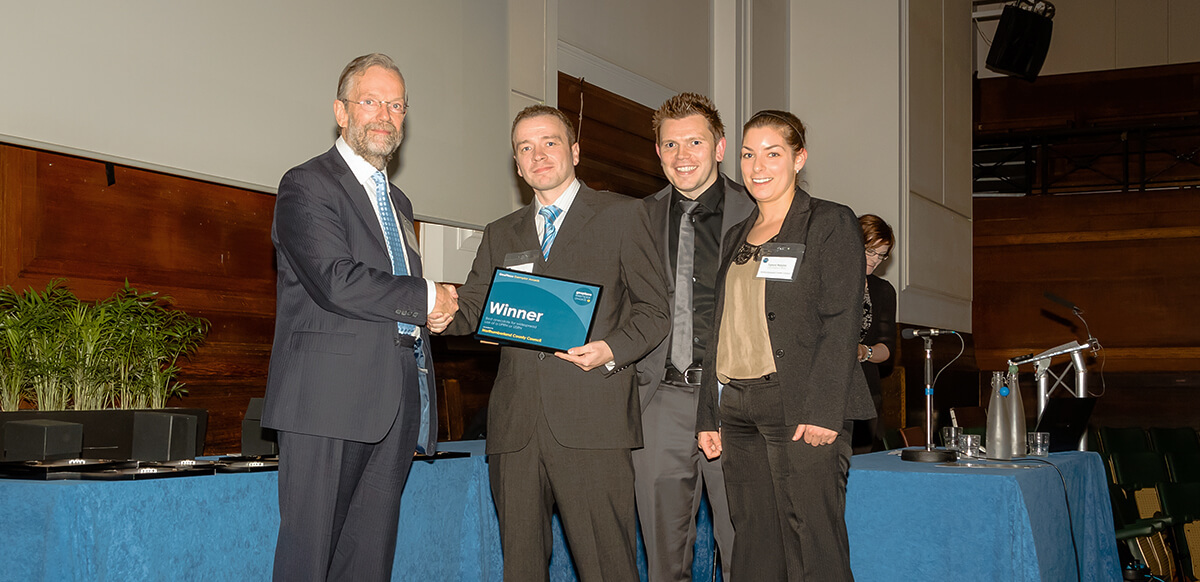
Looking back, it’s clear that during Northumberland’s transition, data quality became a significant issue. Tackling this challenge helped us develop as a team and create new technical approaches that had not been tried before. This work ultimately led to the TOIDy Up Your Data award submission in 2012, three years after LGR. (You can see the presentation slides here).
Day one recommendations:
- ensure a team is in place that clearly understands the plan from the outset.
- make certain that all systems remain fully operational during the transition.
- monitor and plan for any future boundary changes such as parish or ward adjustments and ensure these are consistently reflected in the LLPG.
- use modern software solutions that support APIs for mapping and addressing.
- have an uptodate addressing and street naming and numbering policy ready.
- provide an internal addresslookup tool for colleagues similar to FindMyAddress to encourage consistent use of the UPRN across the authority.
- have a good think and understand the plan with application cross references.
You can find more resources around local government reorganisation here.